V&A museum London

Jo Spence (1934-92), Rosy Martin (Born 1946) Libido Uprising 1989
These photos depict women in two distinct roles: a housewife with a Hoover and a seductress with fishnet tights and a vacuum tube around her leg. These are not just stereotypes, but carefully crafted images. One of the most enlightening aspects of the set “Libido Uprising” is the use of framing. In the first image, the framing is on the woman with the Hoover, which defines her as a housewife; in the second image, the framing is on the woman’s legs in fishnets with a vacuum tube around them, altering our perception of her role.
This framing technique, by juxtaposing two conflicting stereotypes of women, plays a crucial role in defining the photograph’s meaning. It challenges societal expectations by presenting conventional femininity and empowerment side by side. The viewer is compelled to confront the dual standards that society imposes on women, ultimately highlighting the complexities and contradictions inherent in gender roles. The photographs are intricately connected through the overarching theme of gender norms, further emphasized by the specific visual style and meticulous framing technique, underscoring the significance of the topic.
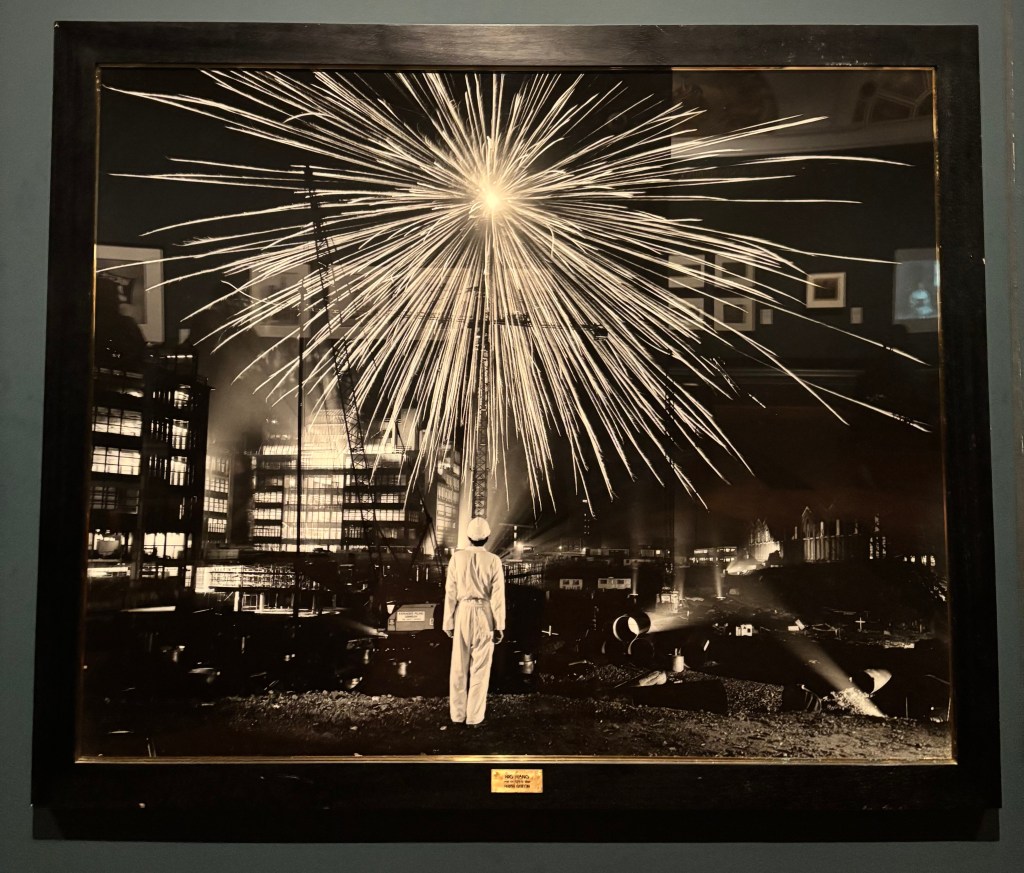
”Big bang” by Brain Griffin, Created in 1856, Influenced by both the Romantic paintings of Caspar Divid Friedrich (1774-1840) and his own time working in englands industrial midlands, Griffin Creats surreal and stricking photographs.
The focus is on the figure in the center and the firework, making for a dramatic and reflective shot. The light from the explosion also helps to define the shot, with a sharp distinction between the dim construction site and the brightly lit sky.
 Photography In London